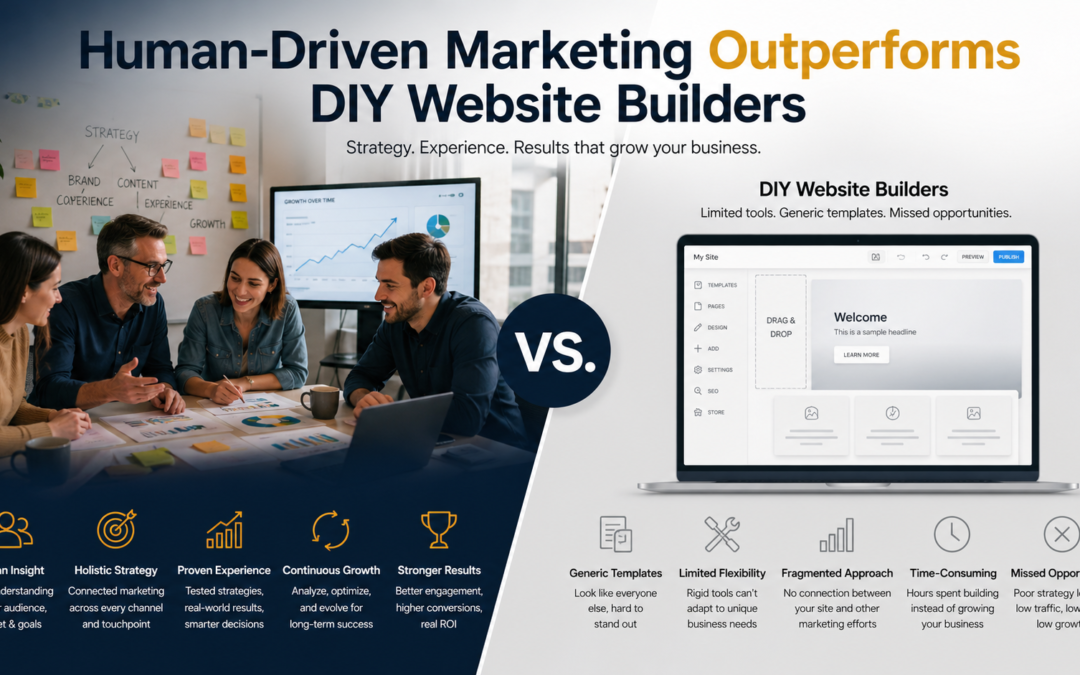
Human-Driven Marketing Outperforms DIY Website Builders

Human-Driven Marketing Outperforms DIY Website Builders

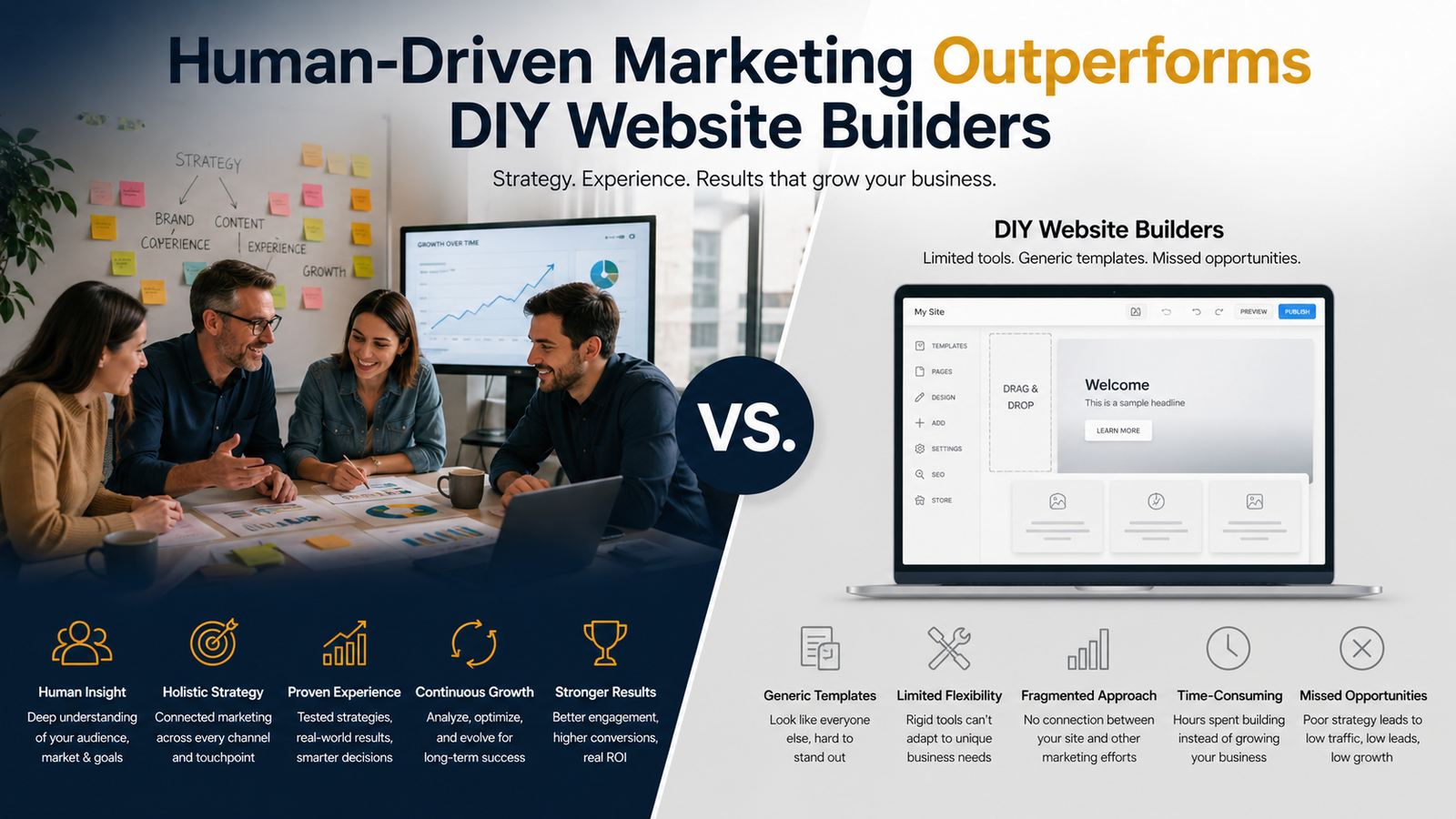
The promise of DIY website builders is seductive: drag-and-drop simplicity, low monthly fees, and the feeling that anyone can spin up a professional online presence in a weekend. For certain use cases—personal projects, basic portfolios, or early-stage ideas—they can be perfectly adequate. But when the goal is meaningful growth, sustained customer engagement, and real competitive differentiation, human-driven marketing with a holistic approach consistently outperforms the templated convenience of a DIY platform.

At the heart of the difference is strategy. A website builder gives you tools; it does not give you judgment. Experienced marketers begin not with templates, but with questions: Who is your audience, really? What motivates them? Where do they hesitate? What does your competitive landscape look like, and where are the gaps? These insights shape everything from messaging to design to channel strategy. A DIY platform can help you assemble pages, but it cannot tell you which story will resonate or why your offer should exist in the first place.

A holistic marketing approach also connects dots that DIY tools leave scattered. Your website is not an island—it’s one touchpoint in a broader ecosystem that includes search visibility, paid acquisition, social media, email nurturing, brand positioning, and customer experience. Human-led teams understand how these elements reinforce one another. They design funnels, not just pages. They think in terms of journeys, not clicks. The result is a system where each component amplifies the others, rather than a standalone site hoping to be discovered.

Experience plays a decisive role here. Seasoned marketers have seen patterns repeat across industries: what converts, what fails quietly, what looks good but underperforms, and what unexpected detail can double engagement. They bring tested frameworks, but also the intuition to know when to break them. DIY platforms, by contrast, rely on generalized best practices baked into templates—useful, but inherently limited. They cannot adapt dynamically to nuanced business contexts or evolving market conditions.

Then there’s the matter of differentiation. Website builders are designed for scale, which means standardization. The same templates, layouts, and UX conventions appear across thousands of sites. Even when customized, they often carry a familiar “feel.” Human-driven marketing pushes beyond that sameness. It crafts a distinct voice, a unique visual identity, and a tailored experience that aligns with your brand’s deeper values. In crowded markets, that distinction isn’t cosmetic—it’s essential.

Another advantage of a human-led approach is adaptability. Markets shift. Customer expectations evolve. Algorithms change. A static site built once on a DIY platform can quickly become outdated or misaligned. In contrast, experienced marketers continuously analyze performance data, run experiments, refine messaging, and iterate on design. They treat marketing as a living system, not a one-time setup. This ongoing optimization compounds over time, producing results that no “set it and forget it” approach can match.

It’s also worth considering the hidden costs of DIY solutions. While the upfront expense is low, the long-term cost of missed opportunities can be significant. Poor conversion rates, unclear messaging, weak positioning, and lack of integration across channels all translate into lost revenue. What appears economical on the surface can become expensive in practice. Human-driven marketing, though a larger initial investment, is designed to generate returns—not just reduce costs.

None of this is to dismiss DIY platforms entirely. They serve a purpose, especially for those testing ideas or operating with minimal resources. But they are tools, not strategies. They excel at execution within predefined boundaries, not at defining the right path forward.

Ultimately, the difference comes down to depth versus convenience. DIY website builders prioritize speed and accessibility. Human-driven marketing prioritizes insight, coherence, and impact. When growth matters—when the stakes involve brand reputation, customer loyalty, and revenue—the latter doesn’t just compete. It wins, often by a wide margin.

Why Local Business Listings Matter More Than Ever

Why Local Business Listings Matter More Than Ever

Local Business Listings: Your Secret Weapon for Getting Found

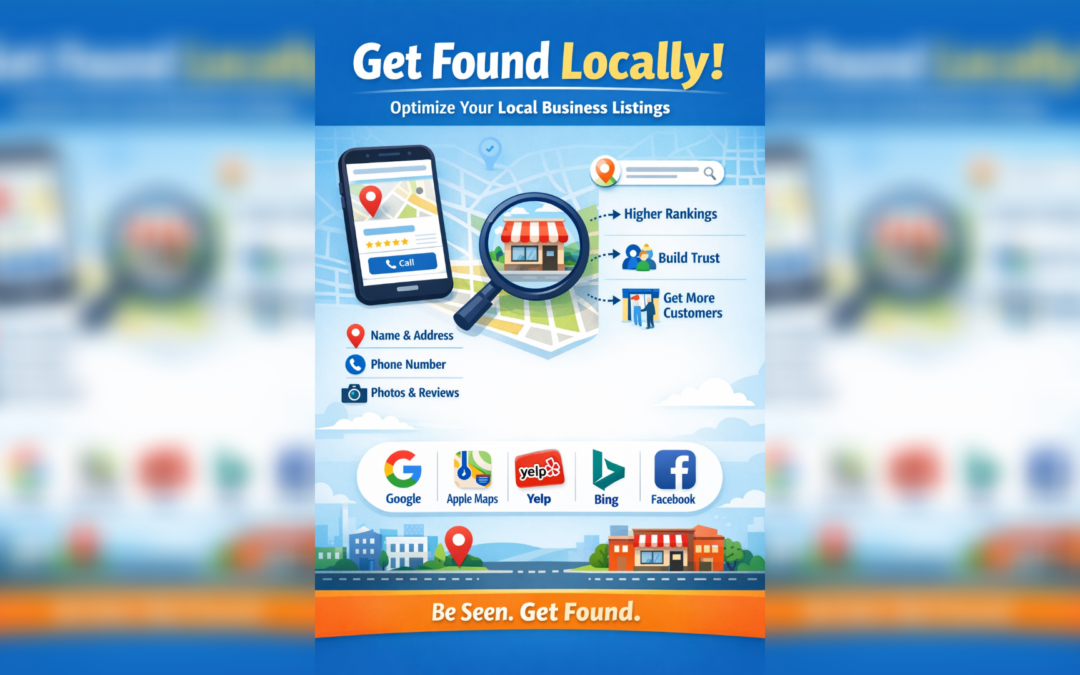
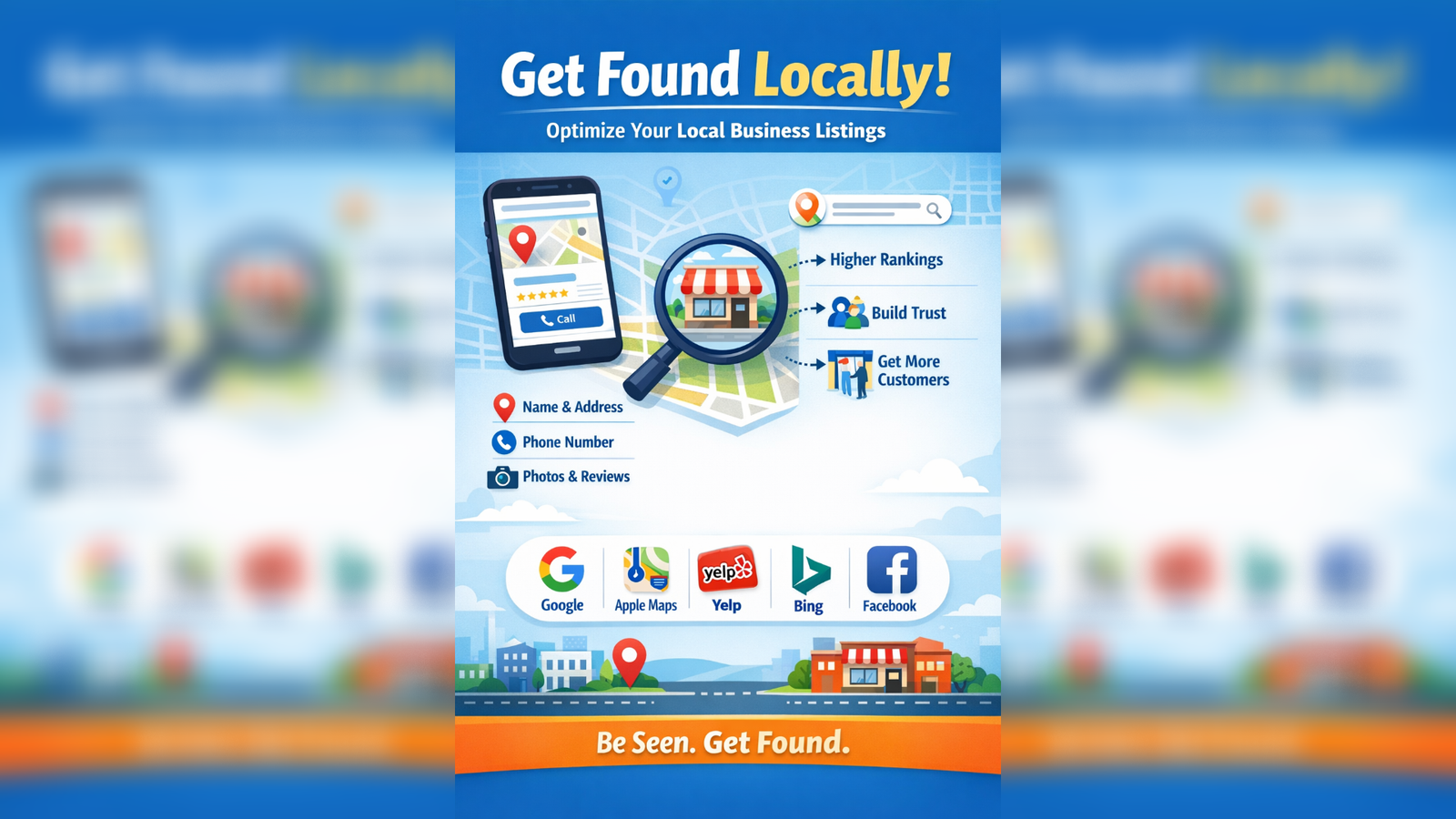
If you’ve ever wondered how customers magically “discover” certain businesses online, here’s the secret: local business listings. They’re the digital version of being on Main Street—except way more powerful.

What They Are (and Why You Should Care)

Local business listings are online profiles that tell people who you are, where you are, and how to reach you. Think of them as your business’s online ID card. When someone searches “coffee near me” or “best plumber in town,” these listings help decide who shows up.

Why They Matter

People trust what they can see. A complete listing with photos, reviews, and updated hours makes your business feel real and reliable. A missing or outdated listing? That’s like having a storefront with the lights off.

The Platforms That Matter Most

You don’t need to be everywhere—just in the right places:

  • Google Business Profile (the big one)

  • Apple Maps

  • Yelp

  • Facebook

  • Bing Places

If you’re in a niche industry, there are specialized directories too.

How to Make Your Listing Shine

  • Add great photos

  • Keep your hours accurate

  • Write a friendly, clear description

  • Encourage happy customers to leave reviews

  • Respond to reviews so people know you’re active

The Payoff

More visibility. More trust. More customers walking through your door or calling your number. Local business listings work quietly in the background, but their impact is huge.

Why “Vibe Marketing” Is Dominating 2026 — And What It Means for Your Brand

Why “Vibe Marketing” Is Dominating 2026 — And What It Means for Your Brand


If the 2010s were defined by data obsession and the early 2020s by personalization at scale, then 2026 has a new north star: vibes.

Yes—actual vibes.

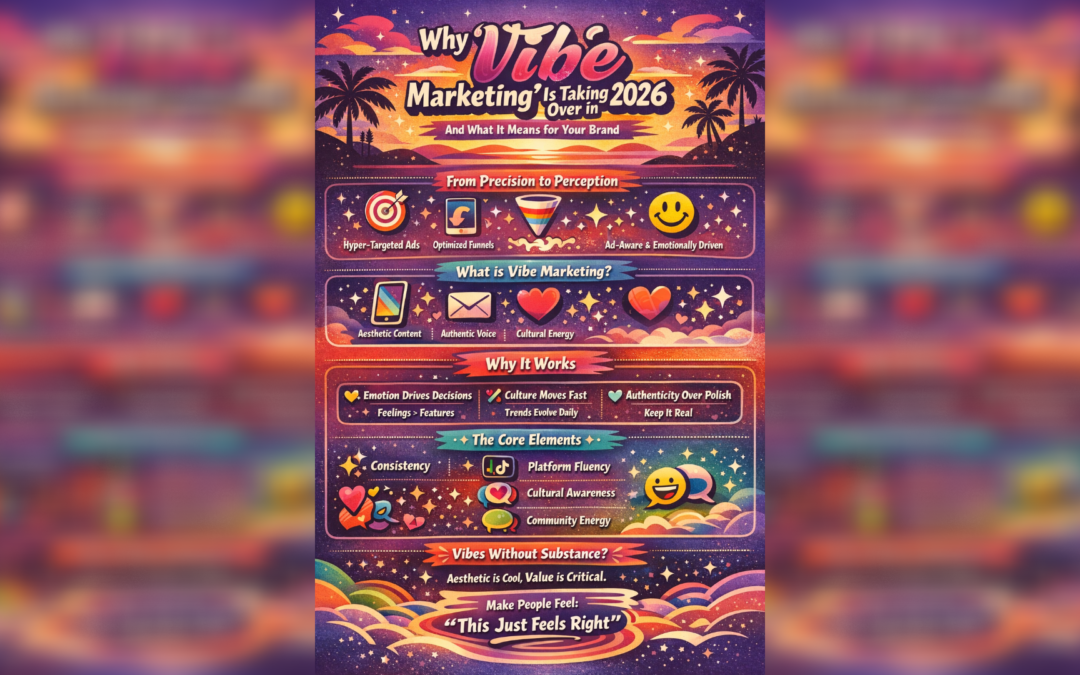
We’ve entered a moment where the emotional aura of your brand carries as much weight as your product features, pricing, or performance. This is the era of vibe marketing, where brands win not by shouting the loudest, but by feeling the most aligned with the culture around them.

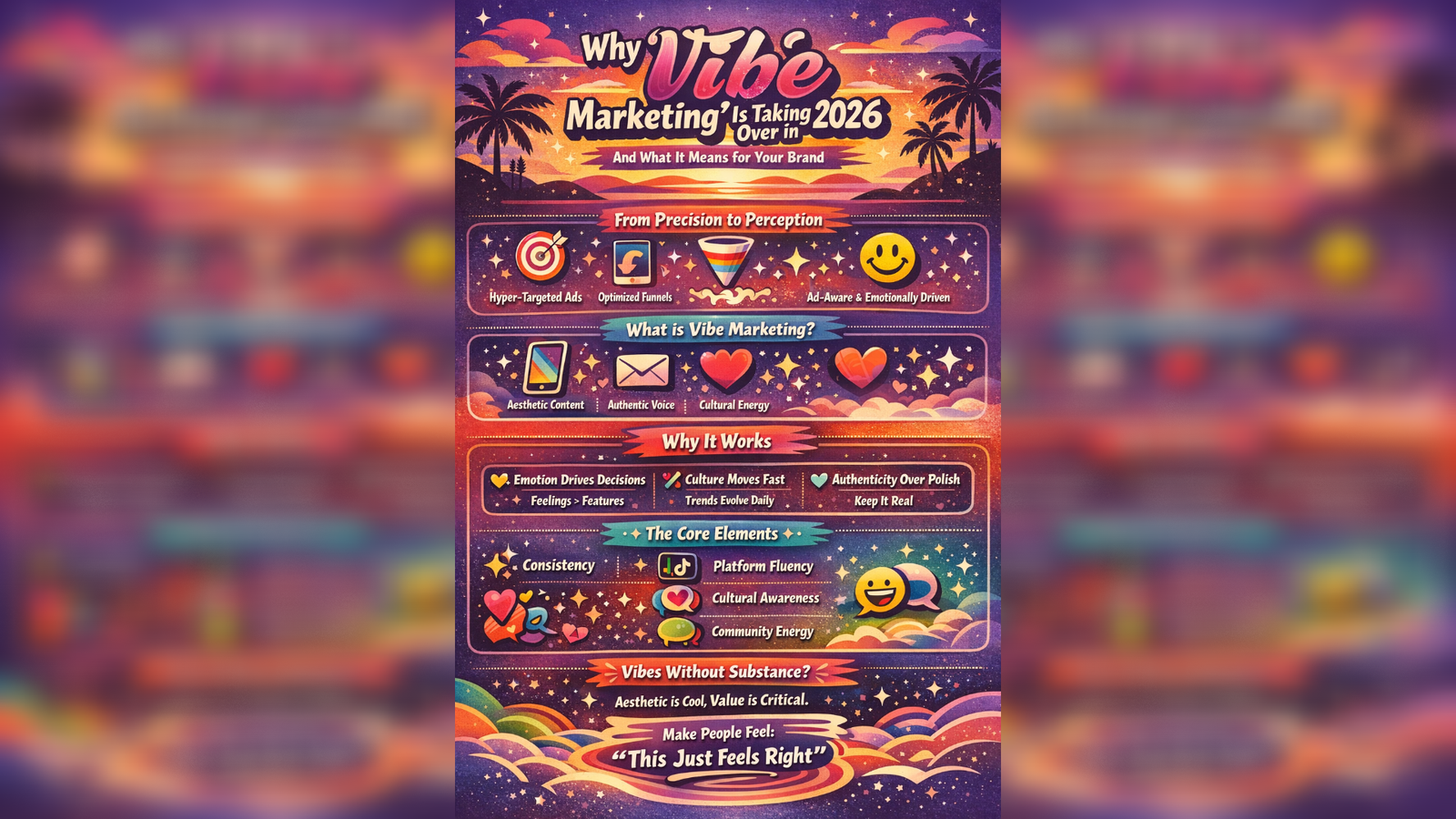
The Shift: From Precision to Perception

For more than a decade, marketing revolved around surgical accuracy:

  • Micro-targeting
  • Funnel engineering
  • A/B testing everything

Those tools still matter—but they no longer differentiate you.

Today’s audiences, especially Gen Z and Gen Alpha, are:

  • Hyper-aware of marketing tactics
  • Fluent in algorithm behavior
  • Motivated by emotional resonance

They don’t just want a product. They want a mirror—a brand that reflects their identity, values, humor, and worldview. If your brand doesn’t feel right, no amount of optimization can compensate.

So… What Is Vibe Marketing?

Vibe marketing is the intentional crafting of a brand’s emotional, aesthetic, and cultural presence.

It goes beyond:

  • Logos
  • Fonts
  • Taglines

It’s the total sensory and emotional experience your brand creates across every touchpoint.

It’s:

  • TikToks that blend into the feed instead of interrupting it
  • Emails that read like a friend, not a corporation
  • Websites that prioritize mood, flow, and personality over dense information

It’s less about campaigns and more about building a living, breathing aesthetic ecosystem.

Why Vibe Marketing Works in 2026

1. Emotion Is the Real Conversion Engine

People forget product specs but remember how you made them feel. A strong vibe creates instant recognition, trust, and loyalty.

2. Culture Moves Faster Than Strategy

Trends now shift in hours, not quarters. Brands that thrive are the ones that can participate in culture—not just analyze it.

3. Imperfection Feels Human

Overly polished content feels artificial. The new premium is authenticity: slightly messy, spontaneous, and real.

4. Algorithms Reward Relatability

Platforms increasingly prioritize content that feels native, not branded. Vibes outperform ads because they blend into the cultural stream.

The Core Elements of a High-Impact Brand Vibe

Consistency Without Rigidity

Your brand should feel recognizable, but not predictable. Think “distinct personality,” not “scripted voice.”

Platform-Native Expression

Each platform has its own language. Vibe marketing adapts the expression without losing the essence.

Cultural Timing

Being early is powerful. Being late is embarrassing. Cultural fluency is now a competitive advantage.

Community Co-Creation

Your audience isn’t passive—they’re collaborators. Comments, stitches, duets, remixes… your vibe becomes a shared space.

Aesthetic Cohesion

Your visuals, tone, pacing, and energy should feel like they belong to the same universe—even when the content varies.

How to Start Building Your Brand Vibe

1. Define Your Emotional Core

Ask: What should people feel after interacting with us?
Not “informed”—but “energized,” “seen,” “inspired,” “amused.”

2. Audit Your Current Presence

Does your website feel like your TikTok?
Does your email tone match your social tone?
If not, you’ve got a vibe gap.

3. Loosen the Brand Guidelines

Rigid rules kill creativity. Give your team permission to experiment, adapt, and play.

4. Create for Insiders, Not Outsiders

Don’t translate content for platforms—speak the native language of each one.

5. Build a Cultural Radar

Track memes, micro-trends, aesthetics, and shifts in tone. Not to chase them—but to understand the environment you’re vibing in.

The Risk: Vibes Without Substance

Let’s be honest: vibes can get you attention, but they can’t fix a weak product.

A strong vibe can spark interest.
But only real value sustains loyalty.

Vibe marketing isn’t a shortcut—it’s an amplifier. If the foundation is shaky, the aesthetic won’t save you.

The Bottom Line

Marketing in 2026 isn’t just about visibility—it’s about emotional resonance.

The brands that win won’t be the ones with the biggest budgets or the most polished campaigns. They’ll be the ones that people encounter and instinctively think:

“This feels like me.”

In a world overflowing with content, that feeling isn’t just nice to have—it’s everything.

The AI Landscape in 2026 – Power Versus Value

The AI Landscape in 2026 – Power Versus Value

The New AI Landscape: Which Tools Actually Deliver Value in 2026?

Artificial intelligence is no longer a single category—it’s an ecosystem. Over the past two years, the market has fractured into specialized domains: large language models powering reasoning and productivity, image generators redefining visual creation, and video tools attempting to automate what was once the most expensive form of content production.

But as capabilities surge, so does confusion. The question is no longer “what can AI do?”—it’s “which tools are actually worth paying for?”

Here’s a grounded look at the current state of AI across its three most important categories, and where real value lies.

The LLM Wars: Power vs Price

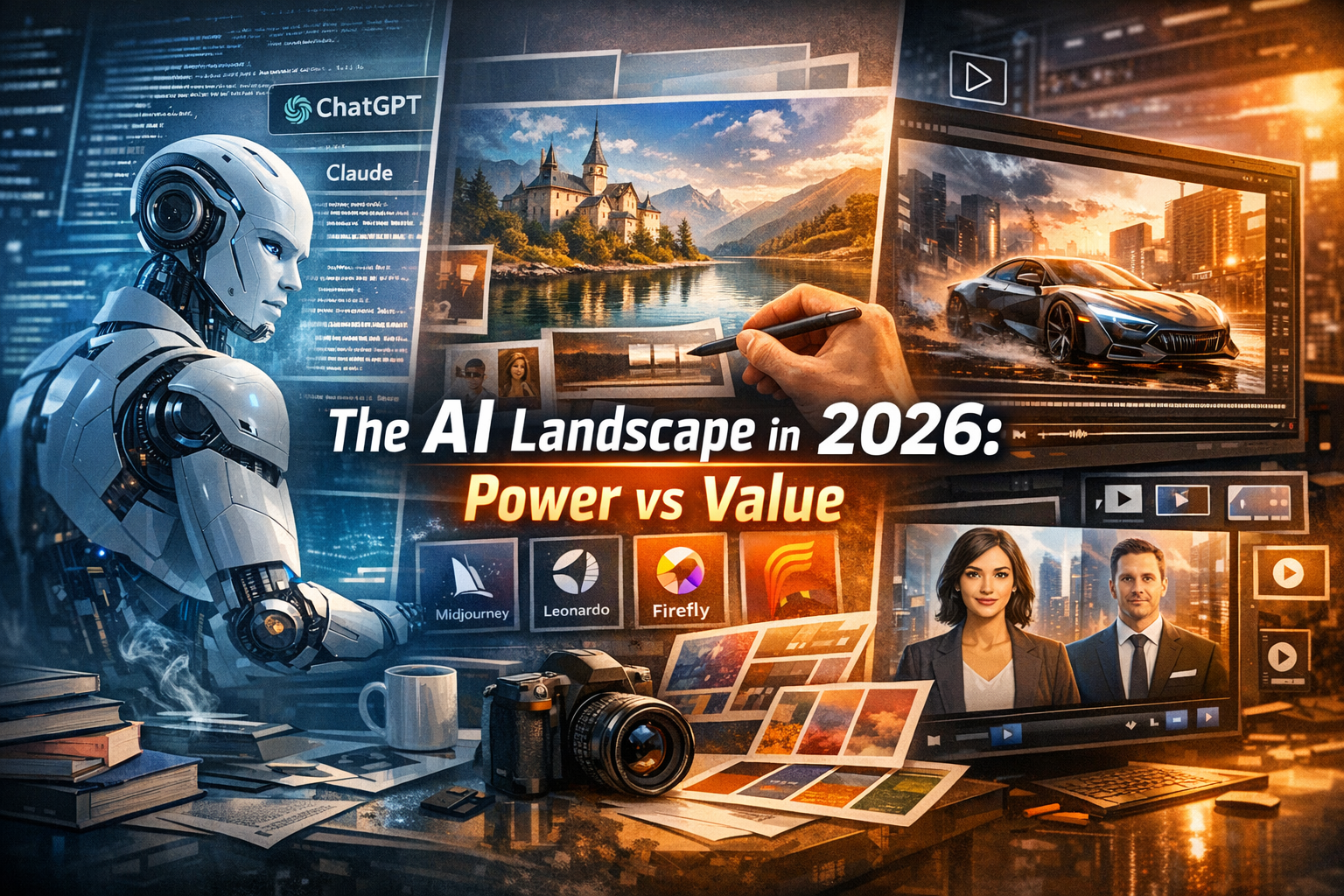
Large language models remain the backbone of the AI revolution. Systems like GPT-4o and Claude Opus represent the cutting edge—capable of complex reasoning, long-form writing, coding, and increasingly, multimodal tasks that blend text, images, and audio.

Yet the most important shift in 2026 isn’t raw capability—it’s pricing divergence.

At the top end, frontier models deliver exceptional reasoning and reliability, but at a steep cost. For high-stakes use—legal drafting, advanced engineering, or research synthesis—they’re often worth it. But these use cases represent a minority of real-world demand.

Instead, the center of gravity has moved toward mid-tier models like Claude Sonnet and GPT-4o mini. These systems achieve something closer to a breakthrough than a compromise: near-premium performance at a fraction of the cost. For most business workflows—emails, reports, coding assistance—they are effectively “good enough,” and dramatically cheaper to scale.

At the bottom end, ultra-low-cost models such as Gemini Flash and DeepSeek V3 are reshaping high-volume applications. They lack consistency and depth, but their pricing makes them ideal for bulk generation tasks like summarization, tagging, or first drafts.

The emerging consensus is clear: the smartest users don’t pick one model—they orchestrate several. Cheap models handle volume, while premium ones refine the final output. In practice, that hybrid approach delivers the best return on investment.

Image Generation: From Novelty to Workflow

If LLMs are the brain of modern AI, image generators have become its creative engine. What began as a novelty—producing surreal or stylized images—has matured into a core part of design, marketing, and content production workflows.

Platforms like Midjourney still dominate when it comes to artistic quality. Its outputs remain among the most visually striking, particularly for cinematic or stylized imagery. But it comes with trade-offs: limited editing control and a workflow that can feel opaque to new users.

Meanwhile, integrated tools such as ChatGPT Image are gaining ground by focusing less on raw image quality and more on usability. The ability to iterate conversationally—refining prompts, editing elements, and combining tasks—has turned image generation into a more fluid, accessible process.

Then there are hybrid platforms like Leonardo AI and Adobe Firefly, which signal a broader shift. These tools aren’t just generators—they’re ecosystems. Templates, asset management, editing pipelines, and commercial licensing are becoming just as important as the images themselves.

That shift explains where the real value lies. The best image generator is no longer the one that produces the single best image—it’s the one that integrates seamlessly into a creative workflow.

For professionals, especially those producing content at scale, bundled platforms often outperform standalone tools in cost-effectiveness, even if their raw output is slightly less impressive.

Video Generation: The Expensive Frontier

If image AI is mature and LLMs are foundational, video generation remains the industry’s most ambitious—and unstable—frontier.

Tools like Sora and Runway Gen-3 have demonstrated what’s possible: short clips with cinematic quality, realistic motion, and increasingly coherent scenes. For the first time, AI can produce video that rivals traditional production—at least in short bursts.

But the economics are still challenging.

Unlike text or images, video is computationally expensive. Pricing often scales by seconds generated, and costs can rise quickly for longer or higher-quality clips. Even with subscription models, heavy users can find themselves constrained by limits or credits.

As a result, the market has split into three distinct segments.

At the high end, cinematic models offer unmatched quality but are difficult to justify outside premium use cases like advertising or film prototyping. In the middle, tools such as Pika and Luma AI focus on short-form content—optimized for social media, where volume matters more than perfection. At the practical end, avatar-based platforms like Synthesia and HeyGen prioritize scalability, enabling businesses to produce training videos, marketing content, or internal communications at low cost.

For now, the best value lies squarely in the middle tier. Tools that balance quality with affordability—and allow frequent iteration—are delivering the strongest return for creators and businesses alike.

A Market Defined by Trade-Offs

Across all three categories, a pattern is emerging. The AI market is no longer about finding the “best” tool—it’s about navigating trade-offs between quality, cost, and workflow integration.

LLMs are largely solved from a capability standpoint, but pricing strategy determines real-world value. Image generation has shifted toward ecosystem dominance, where usability and integration matter more than marginal gains in quality. Video, meanwhile, remains a frontier technology—powerful, but not yet economically efficient at scale.

Perhaps the most important takeaway is this: the highest-performing tools are rarely the most cost-effective. And the most cost-effective tools are rarely the most powerful.

The winners in this new landscape are not the tools themselves, but the users who understand how to combine them.

The Bottom Line

In 2026, the “best” AI stack isn’t a single product—it’s a layered system:

  • A mid-tier LLM for everyday thinking and production

  • A workflow-oriented image platform for creative assets

  • A cost-efficient video tool for distribution and scale

Used together, these tools don’t just enhance productivity—they redefine it.

And as competition intensifies and prices continue to fall, one thing is becoming clear: the real disruption isn’t just what AI can do, but how cheaply it can now do it.

57 Words That Make People Click: The Psychology of Action-Driven Copy

57 Words That Make People Click: The Psychology of Action-Driven Copy

57 Words That Make People Click: The Psychology of Action-Driven Copy

If you’ve ever wondered why some headlines make you immediately click while others fade into the background, the answer is simple: words trigger action.

In marketing, product design, and conversion optimization, the right words can transform passive readers into active users. A single word in a button, headline, or call-to-action can dramatically increase engagement, signups, and sales.

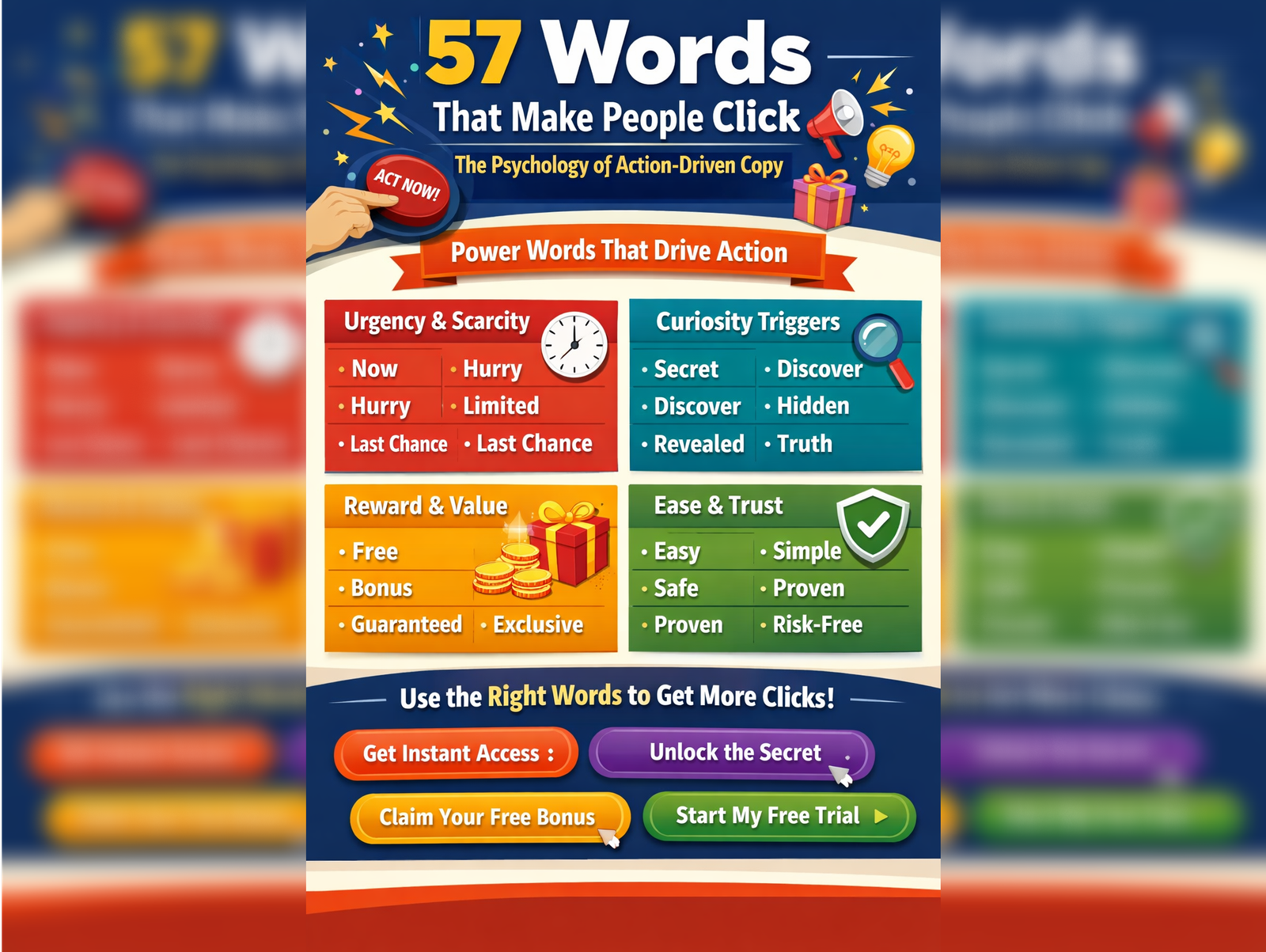
Below are 57 powerful action-driving words used by high-performing marketers, copywriters, and UX designers to motivate users to take the next step.

Why Certain Words Trigger Action

Human decision-making is emotional first and logical second. Words that work well usually tap into one of these psychological triggers:

  • Urgency – pushes users to act now

  • Curiosity – makes people want to learn more

  • Security – reduces fear or risk

  • Reward – promises benefit or gain

  • Ease – makes the action feel simple

Great copy uses these triggers strategically.

The 57 Most Action-Driving Words

Urgency & Scarcity

These words create a sense that waiting means missing out.

  1. Now

  2. Today

  3. Hurry

  4. Limited

  5. Deadline

  6. Last Chance

  7. Closing

  8. Ending

  9. Final

  10. Instant

Curiosity Triggers

These words make users feel like they’re about to discover something valuable.

  1. Secret

  2. Revealed

  3. Hidden

  4. Insider

  5. Discover

  6. Unlocked

  7. Surprising

  8. Little-known

  9. Breakthrough

  10. Truth

Reward & Value

These words highlight what users gain.

  1. Free

  2. Bonus

  3. Exclusive

  4. Premium

  5. Proven

  6. Guaranteed

  7. Best

  8. Results

  9. Powerful

  10. Ultimate

Ease & Simplicity

Users are far more likely to act when something feels easy and low effort.

  1. Simple

  2. Easy

  3. Quick

  4. Effortless

  5. Fast

  6. Step-by-step

  7. Done-for-you

  8. Starter

  9. Beginner

  10. Shortcut

Trust & Safety

These reduce hesitation and build confidence in the decision.

  1. Safe

  2. Secure

  3. Trusted

  4. Official

  5. Verified

  6. Risk-Free

  7. Backed

  8. Certified

Direct Action Words

These clearly tell the user what to do next.

  1. Get

  2. Start

  3. Join

  4. Claim

  5. Unlock

  6. Try

  7. Download

  8. Build

  9. Create

How to Use These Words Effectively

The real power comes from combining them in compelling calls to action.

Examples:

  • “Get Instant Access”

  • “Claim Your Free Bonus Today”

  • “Discover the Hidden Strategy”

  • “Start Your Risk-Free Trial”

  • “Unlock the Secret Method”

These combinations trigger curiosity, urgency, and reward at the same time.

Where These Words Work Best

You’ll see the biggest impact when using these words in:

  • Headlines

  • CTA buttons

  • Email subject lines

  • Landing pages

  • Ads

  • Product onboarding flows

  • Pop-ups and banners

Even small tweaks like changing “Submit” → “Get My Free Guide” can significantly improve conversion rates.

Final Thought

Great marketing isn’t about more words — it’s about the right words.

The 57 above have been proven across thousands of campaigns to drive engagement and action. When used thoughtfully, they can turn casual readers into committed users.

Your next experiment could be as simple as changing one button.

Because sometimes one word is all it takes to make someone click.

Need Help?

47 Ways To Drive High Quality Traffic To Your Website

47 Ways To Drive High Quality Traffic To Your Website

Driving traffic to your website is one of the most important goals for any online business, content creator, or digital marketer. However, not all website traffic delivers the same value. While some visitors may land on your site and quickly leave, high-quality traffic consists of users who are genuinely interested in your content, products, or services. These visitors are far more likely to engage with your brand, explore multiple pages, subscribe to your email list, or become paying customers.

In today’s competitive digital landscape, simply publishing content or launching a website is not enough to attract meaningful traffic. Search engines prioritize relevance, user experience, and authority, while audiences are constantly flooded with content from countless sources. To stand out, businesses must implement a strategic approach that combines search engine optimization, content marketing, social media promotion, partnerships, and ongoing optimization.

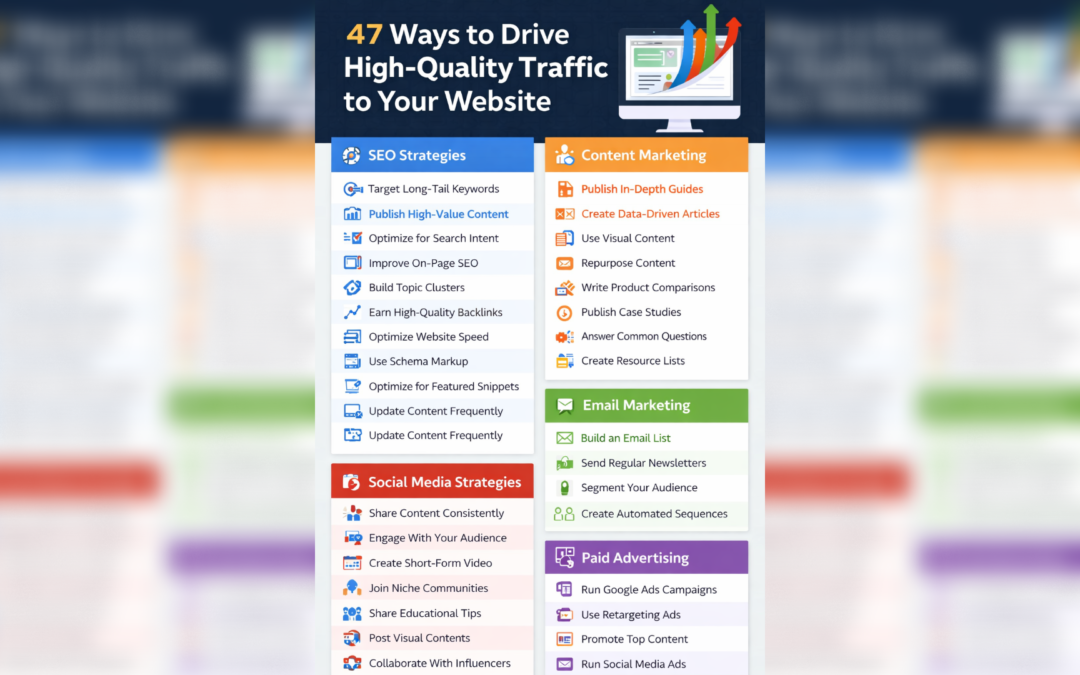
This comprehensive guide explores 47 powerful strategies to help you attract high-quality visitors to your website. Each tactic focuses not only on increasing traffic numbers but also on bringing in the right audience—people who are actively searching for the information, products, or solutions you provide.

By applying these strategies consistently, you can build a sustainable stream of targeted visitors and position your website as a trusted resource within your industry.

What Is High-Quality Website Traffic?

High-quality traffic refers to visitors who arrive at your website with genuine interest and clear intent. These users are more likely to engage with your content, stay on your site longer, and take meaningful actions such as subscribing, sharing, or purchasing.

Several factors determine the quality of website traffic. One of the most important is relevance. When your content closely matches what users are searching for, they are more likely to find value in your website and continue exploring.

Another important factor is user intent. Someone searching for “how to improve website SEO” has a very different goal than someone searching for “buy SEO services.” Understanding these differences helps you create content that matches user expectations.

Engagement metrics also reveal traffic quality. Visitors who spend time reading articles, clicking through pages, and interacting with your content indicate that your website is attracting the right audience.

Finally, conversion potential is a key indicator. High-quality visitors are much more likely to become subscribers, leads, or customers.

The goal of your traffic strategy should therefore be to attract visitors who align with your content and business objectives.

Why High-Quality Traffic Matters

Many website owners become focused on increasing raw traffic numbers, but traffic volume alone does not guarantee success. A website receiving thousands of untargeted visitors may still struggle to generate leads or sales.

High-quality traffic provides several important benefits.

First, it increases engagement. When visitors find exactly what they are looking for, they are more likely to read your content, explore additional pages, and interact with your brand.

Second, it improves conversion rates. Visitors who already have interest in your topic or solution are much more likely to subscribe to your email list or purchase your products.

Third, it strengthens search engine rankings. Search engines analyze user behavior signals such as time on page, bounce rate, and engagement. When visitors stay longer and interact with your content, search engines interpret this as a sign of quality.

Finally, high-quality traffic builds long-term brand authority. When people repeatedly find helpful information on your website, they begin to trust your expertise.

For these reasons, focusing on attracting the right audience is far more valuable than simply increasing visitor numbers.

SEO Strategies to Drive High-Quality Traffic

Search engine optimization remains one of the most powerful ways to generate targeted traffic. People who discover your website through search engines are often actively looking for solutions, which makes them highly valuable visitors.

1. Target Long-Tail Keywords

Long-tail keywords are longer, more specific search phrases that usually have lower competition. These keywords often attract visitors who are closer to making decisions because they have a clear idea of what they want.

For example, someone searching for “marketing tips” may simply be exploring ideas, while someone searching for “digital marketing tips for small businesses” likely has a specific goal.

By targeting these more detailed phrases, you can attract visitors who are actively seeking your expertise.

2. Publish High-Value Blog Content

One of the most effective ways to attract organic traffic is by consistently publishing helpful blog content. Educational articles, tutorials, and expert insights provide value to readers while also increasing the number of pages search engines can index.

High-quality blog content positions your website as a trusted resource and encourages visitors to return for additional information.

3. Optimize for Search Intent

Search intent refers to the reason behind a user’s search query. Understanding this intent is essential for creating content that satisfies user expectations.

Some searches are informational, while others are navigational or transactional. Tailoring your content to match the intent behind each keyword significantly increases your chances of ranking well in search results.

4. Improve On-Page SEO

On-page SEO involves optimizing elements within your website to improve search visibility. These elements include title tags, meta descriptions, headings, keyword placement, and internal links.

Proper on-page optimization helps search engines understand your content while also improving readability for users.

5. Build Topic Clusters

Topic clusters organize related content around a central pillar page. The pillar page provides a comprehensive overview of a topic, while supporting articles explore specific subtopics in greater detail.

This structure helps search engines recognize your expertise and strengthens internal linking across your website.

6. Earn High-Quality Backlinks

Backlinks remain one of the most important ranking factors for search engines. When reputable websites link to your content, it signals that your information is trustworthy and valuable.

Focus on creating link-worthy content such as research studies, comprehensive guides, or unique insights that others want to reference.

7. Optimize Website Speed

Page speed plays a significant role in both user experience and search rankings. Visitors expect websites to load quickly, and slow pages often cause users to leave before engaging with the content.

Improving site speed can dramatically increase user satisfaction and reduce bounce rates.

8. Use Schema Markup

Schema markup provides additional context to search engines by using structured data. This can help your pages appear in enhanced search results such as rich snippets, which often attract higher click-through rates.

9. Optimize for Featured Snippets

Featured snippets appear at the top of search results and provide quick answers to user questions. Structuring your content with clear headings and concise explanations increases the chances of being selected for these positions.

10. Update and Refresh Existing Content

Older articles may lose relevance over time, especially as industries evolve. Updating outdated content with new statistics, improved formatting, and additional insights can significantly boost rankings and traffic.

Content Marketing Strategies

Content marketing focuses on creating valuable resources that attract and educate your audience. High-quality content naturally draws visitors who are interested in your topic.

11. Publish In-Depth Guides

Comprehensive guides often perform well in search engines because they cover topics thoroughly. These articles become valuable reference resources that readers bookmark and share.

12. Create Data-Driven Articles

Original research and data-driven content provide unique insights that other websites may reference and link to.

13. Use Visual Content

Visual elements such as charts, diagrams, and infographics help simplify complex information. They also increase the likelihood that readers will share your content on social media.

14. Repurpose Content

Repurposing allows you to extend the reach of your existing content. A single blog post can be transformed into a video, podcast episode, infographic, or social media series.

15. Write Product Comparison Articles

Comparison articles help readers evaluate different solutions. These posts often attract visitors who are already considering a purchase.

16. Publish Case Studies

Case studies demonstrate real-world results and provide evidence that your strategies or products work.

17. Answer Common Questions

Creating content that answers frequently asked questions helps attract visitors who are actively searching for solutions.

18. Create Resource Lists

Curated lists of tools, websites, or strategies provide practical value and often attract backlinks from other content creators.

Social Media Strategies

Social media platforms offer powerful opportunities to expand your reach and introduce your content to new audiences.

19. Share Content Consistently

Regular posting keeps your audience engaged and increases the likelihood that your content will appear in feeds.

20. Engage With Your Audience

Responding to comments and starting conversations helps build relationships with followers.

21. Create Short-Form Video

Short videos can quickly capture attention and drive traffic to your website.

22. Participate in Niche Communities

Industry groups and communities provide opportunities to share insights and connect with targeted audiences.

23. Share Educational Tips

Quick, helpful tips often perform well on social media and encourage users to learn more.

24. Use Visual Posts

Images and carousel posts tend to generate higher engagement than text-only updates.

25. Collaborate With Influencers

Influencers have built trust with their audiences, and partnerships can introduce your brand to new followers.

26. Run Social Media Contests

Contests and giveaways can generate excitement and attract visitors to your website.

Email Marketing Strategies

Email marketing remains one of the most effective channels for driving repeat website traffic.

27. Build an Email Subscriber List

Offering valuable lead magnets encourages visitors to subscribe.

28. Send Regular Newsletters

Newsletters keep subscribers informed about new content and updates.

29. Segment Your Audience

Segmented lists allow you to send personalized content to different groups.

30. Create Automated Email Sequences

Automated sequences nurture relationships with subscribers and guide them toward deeper engagement.

Paid Traffic Strategies

Paid advertising can help accelerate traffic growth and reach targeted audiences quickly.

31. Run Search Engine Ads

Search ads target users who are actively searching for specific solutions.

32. Use Retargeting Ads

Retargeting campaigns remind previous visitors about your website.

33. Promote High-Performing Content

Boosting popular articles can expand their reach.

34. Run Social Media Ads

Social platforms allow precise audience targeting based on interests and behavior.

35. Test Multiple Ad Variations

Testing different headlines and visuals helps identify the most effective campaigns.

Partnerships and Community Strategies

Collaborations can dramatically expand your reach.

36. Write Guest Blog Posts

Guest blogging introduces your expertise to new audiences.

37. Appear on Podcasts

Podcast interviews allow you to share insights and direct listeners to your website.

38. Host Webinars

Educational webinars attract highly engaged audiences.

39. Partner With Complementary Brands

Joint collaborations help both brands reach new markets.

40. Participate in Online Forums

Answering questions in communities can drive targeted visitors.

Authority and Brand Building

Building authority strengthens trust and attracts loyal audiences.

41. Develop a Personal Brand

People connect with individuals more than anonymous brands.

42. Publish Thought Leadership Articles

Industry insights position you as an expert.

43. Speak at Virtual Events

Online conferences expand visibility.

44. Create Free Tools

Useful tools attract backlinks and recurring traffic.

Optimization Strategies

Optimization ensures that your traffic produces meaningful results.

45. Optimize Landing Pages

Clear messaging and strong calls to action improve conversions.

46. Use Exit-Intent Popups

Exit-intent popups capture leads before visitors leave your website.

47. Analyze Website Analytics

Analyzing traffic data helps you identify which strategies are working best.

Conclusion

Driving high-quality traffic to your website requires a balanced combination of search engine optimization, content marketing, social media engagement, partnerships, and continuous improvement.

Rather than relying on a single strategy, successful websites implement multiple approaches that work together to attract targeted visitors and build long-term authority.

By consistently publishing valuable content, understanding your audience’s needs, and refining your marketing strategy based on data, you can create a sustainable flow of high-quality traffic that supports your business growth.

The key is consistency. Implement these strategies gradually, measure your results, and continue improving your approach. Over time, your website will become a trusted resource that attracts engaged visitors who are eager to learn from you and interact with your brand.

Need Help?

Copyright © 2025 Sayward Marketing | Proudly Canadian Eh! Canadian Flag