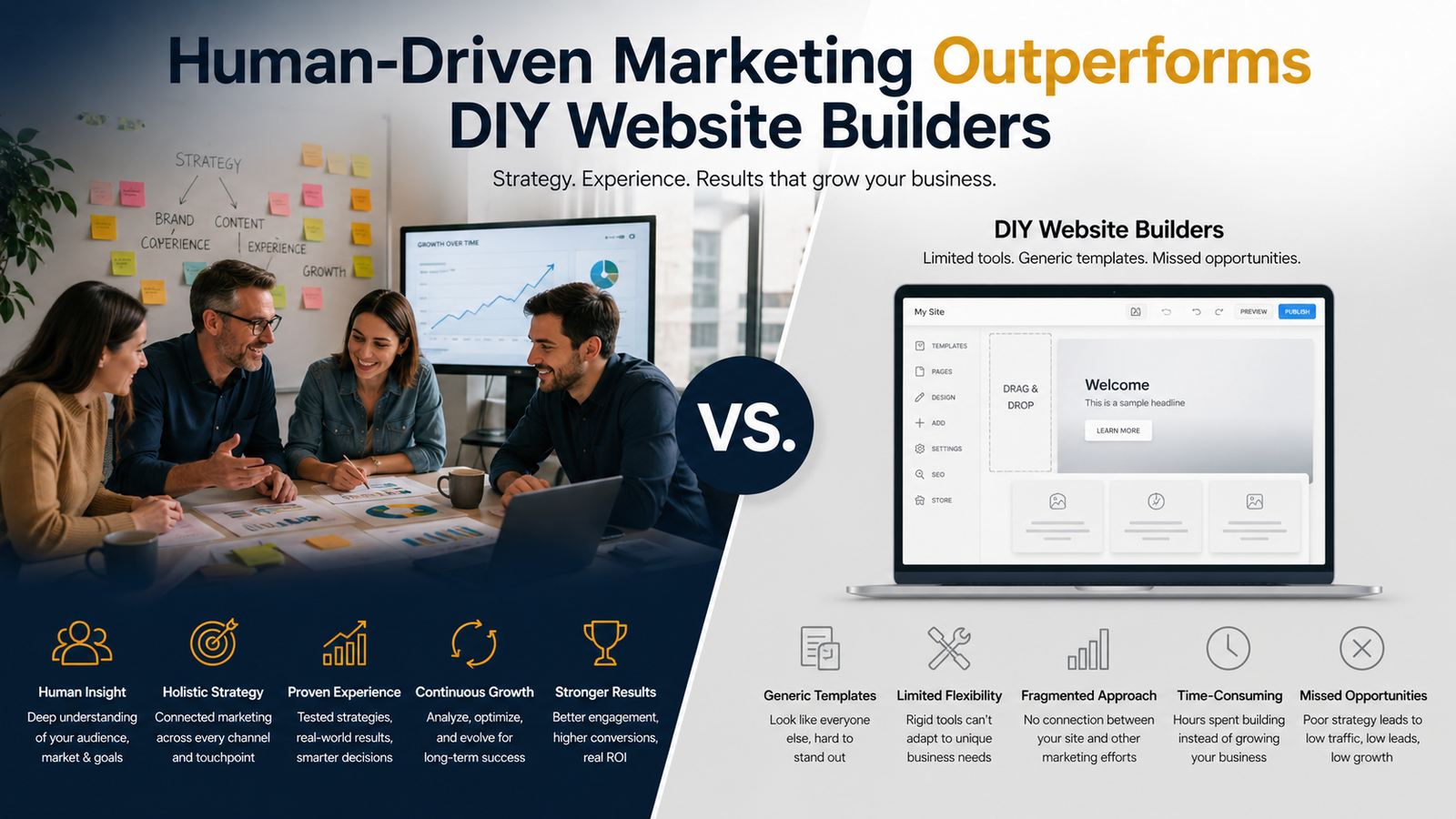
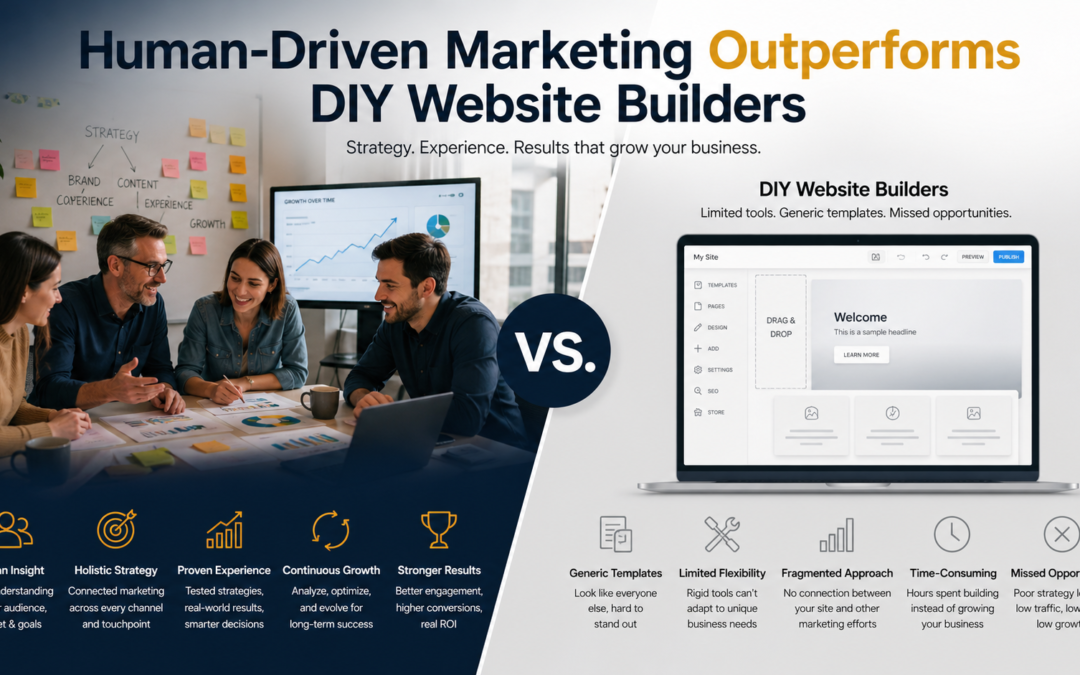
The promise of DIY website builders is seductive: drag-and-drop simplicity, low monthly fees, and the feeling that anyone can spin up a professional online presence in a weekend. For certain use cases—personal projects, basic portfolios, or early-stage ideas—they can be perfectly adequate. But when the goal is meaningful growth, sustained customer engagement, and real competitive differentiation, human-driven marketing with a holistic approach consistently outperforms the templated convenience of a DIY platform.
At the heart of the difference is strategy. A website builder gives you tools; it does not give you judgment. Experienced marketers begin not with templates, but with questions: Who is your audience, really? What motivates them? Where do they hesitate? What does your competitive landscape look like, and where are the gaps? These insights shape everything from messaging to design to channel strategy. A DIY platform can help you assemble pages, but it cannot tell you which story will resonate or why your offer should exist in the first place.
A holistic marketing approach also connects dots that DIY tools leave scattered. Your website is not an island—it’s one touchpoint in a broader ecosystem that includes search visibility, paid acquisition, social media, email nurturing, brand positioning, and customer experience. Human-led teams understand how these elements reinforce one another. They design funnels, not just pages. They think in terms of journeys, not clicks. The result is a system where each component amplifies the others, rather than a standalone site hoping to be discovered.
Experience plays a decisive role here. Seasoned marketers have seen patterns repeat across industries: what converts, what fails quietly, what looks good but underperforms, and what unexpected detail can double engagement. They bring tested frameworks, but also the intuition to know when to break them. DIY platforms, by contrast, rely on generalized best practices baked into templates—useful, but inherently limited. They cannot adapt dynamically to nuanced business contexts or evolving market conditions.
Then there’s the matter of differentiation. Website builders are designed for scale, which means standardization. The same templates, layouts, and UX conventions appear across thousands of sites. Even when customized, they often carry a familiar “feel.” Human-driven marketing pushes beyond that sameness. It crafts a distinct voice, a unique visual identity, and a tailored experience that aligns with your brand’s deeper values. In crowded markets, that distinction isn’t cosmetic—it’s essential.
Another advantage of a human-led approach is adaptability. Markets shift. Customer expectations evolve. Algorithms change. A static site built once on a DIY platform can quickly become outdated or misaligned. In contrast, experienced marketers continuously analyze performance data, run experiments, refine messaging, and iterate on design. They treat marketing as a living system, not a one-time setup. This ongoing optimization compounds over time, producing results that no “set it and forget it” approach can match.
It’s also worth considering the hidden costs of DIY solutions. While the upfront expense is low, the long-term cost of missed opportunities can be significant. Poor conversion rates, unclear messaging, weak positioning, and lack of integration across channels all translate into lost revenue. What appears economical on the surface can become expensive in practice. Human-driven marketing, though a larger initial investment, is designed to generate returns—not just reduce costs.
None of this is to dismiss DIY platforms entirely. They serve a purpose, especially for those testing ideas or operating with minimal resources. But they are tools, not strategies. They excel at execution within predefined boundaries, not at defining the right path forward.
Ultimately, the difference comes down to depth versus convenience. DIY website builders prioritize speed and accessibility. Human-driven marketing prioritizes insight, coherence, and impact. When growth matters—when the stakes involve brand reputation, customer loyalty, and revenue—the latter doesn’t just compete. It wins, often by a wide margin.