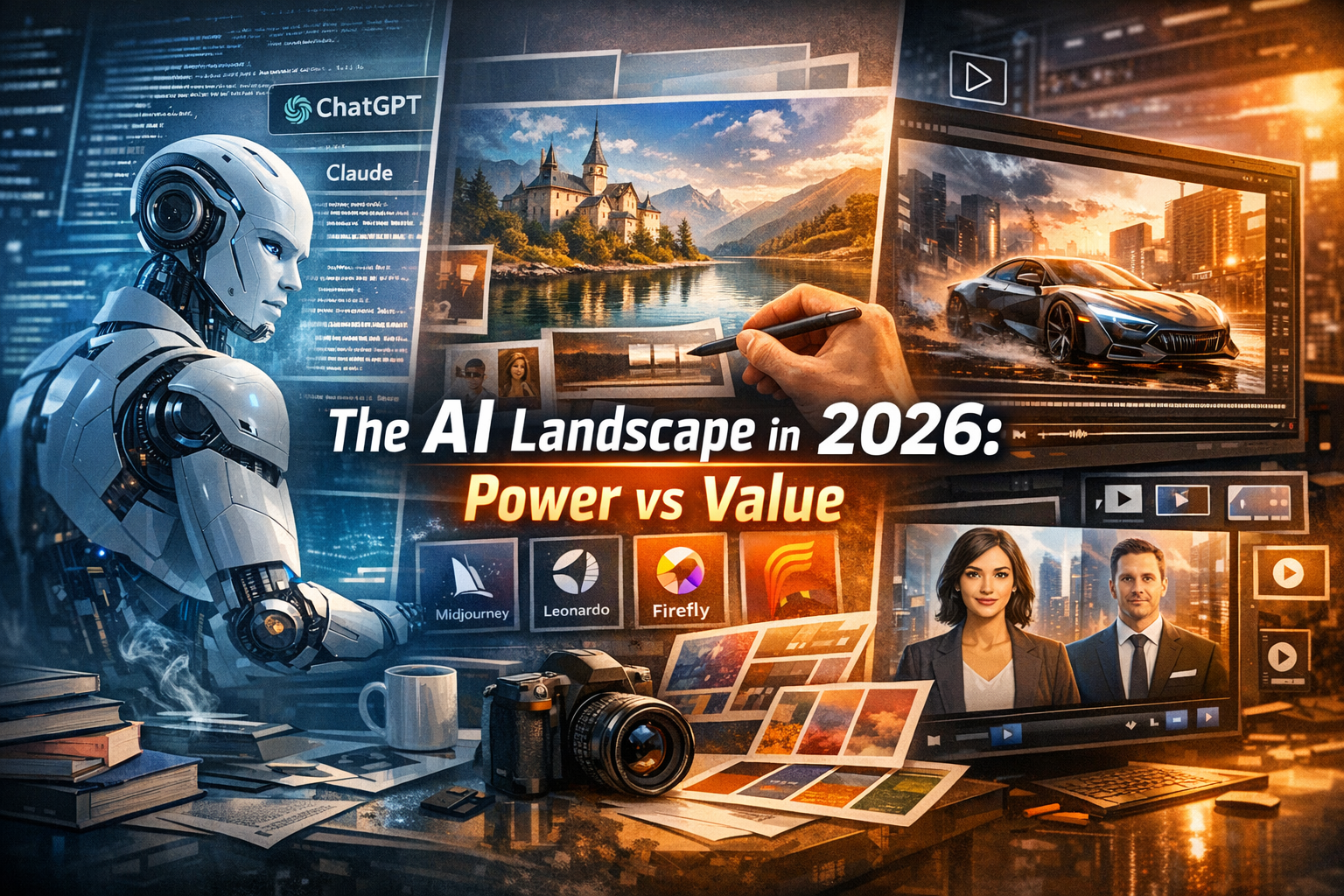
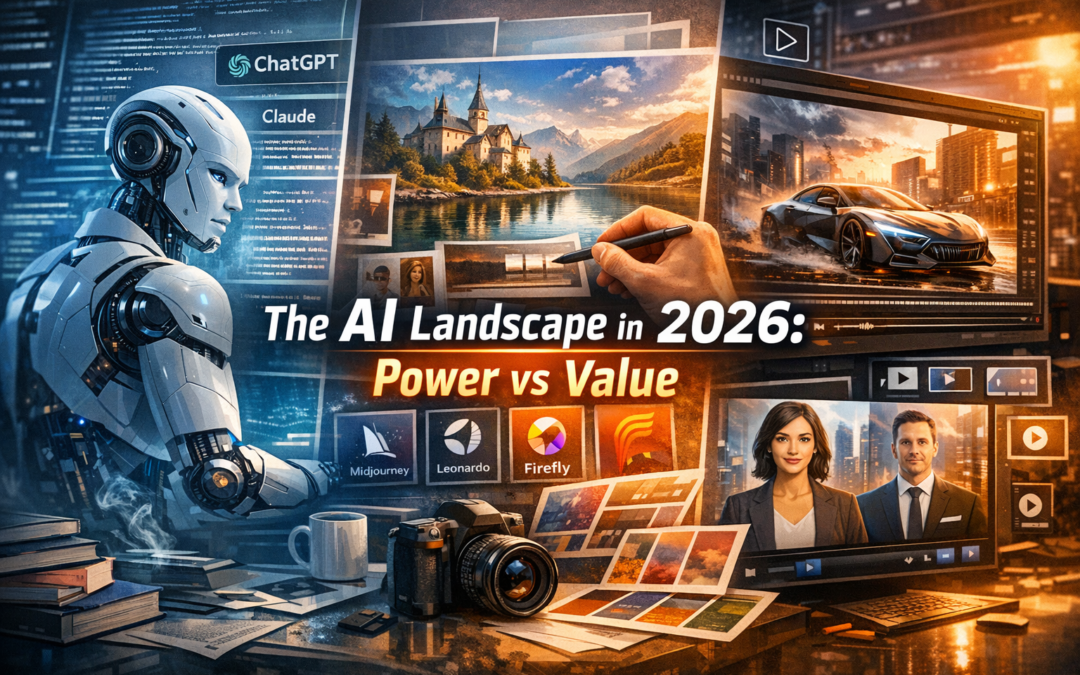
The AI Landscape in 2026 – Power Versus Value
The New AI Landscape: Which Tools Actually Deliver Value in 2026?
Artificial intelligence is no longer a single category—it’s an ecosystem. Over the past two years, the market has fractured into specialized domains: large language models powering reasoning and productivity, image generators redefining visual creation, and video tools attempting to automate what was once the most expensive form of content production.
But as capabilities surge, so does confusion. The question is no longer “what can AI do?”—it’s “which tools are actually worth paying for?”
Here’s a grounded look at the current state of AI across its three most important categories, and where real value lies.
The LLM Wars: Power vs Price
Large language models remain the backbone of the AI revolution. Systems like GPT-4o and Claude Opus represent the cutting edge—capable of complex reasoning, long-form writing, coding, and increasingly, multimodal tasks that blend text, images, and audio.
Yet the most important shift in 2026 isn’t raw capability—it’s pricing divergence.
At the top end, frontier models deliver exceptional reasoning and reliability, but at a steep cost. For high-stakes use—legal drafting, advanced engineering, or research synthesis—they’re often worth it. But these use cases represent a minority of real-world demand.
Instead, the center of gravity has moved toward mid-tier models like Claude Sonnet and GPT-4o mini. These systems achieve something closer to a breakthrough than a compromise: near-premium performance at a fraction of the cost. For most business workflows—emails, reports, coding assistance—they are effectively “good enough,” and dramatically cheaper to scale.
At the bottom end, ultra-low-cost models such as Gemini Flash and DeepSeek V3 are reshaping high-volume applications. They lack consistency and depth, but their pricing makes them ideal for bulk generation tasks like summarization, tagging, or first drafts.
The emerging consensus is clear: the smartest users don’t pick one model—they orchestrate several. Cheap models handle volume, while premium ones refine the final output. In practice, that hybrid approach delivers the best return on investment.
Image Generation: From Novelty to Workflow
If LLMs are the brain of modern AI, image generators have become its creative engine. What began as a novelty—producing surreal or stylized images—has matured into a core part of design, marketing, and content production workflows.
Platforms like Midjourney still dominate when it comes to artistic quality. Its outputs remain among the most visually striking, particularly for cinematic or stylized imagery. But it comes with trade-offs: limited editing control and a workflow that can feel opaque to new users.
Meanwhile, integrated tools such as ChatGPT Image are gaining ground by focusing less on raw image quality and more on usability. The ability to iterate conversationally—refining prompts, editing elements, and combining tasks—has turned image generation into a more fluid, accessible process.
Then there are hybrid platforms like Leonardo AI and Adobe Firefly, which signal a broader shift. These tools aren’t just generators—they’re ecosystems. Templates, asset management, editing pipelines, and commercial licensing are becoming just as important as the images themselves.
That shift explains where the real value lies. The best image generator is no longer the one that produces the single best image—it’s the one that integrates seamlessly into a creative workflow.
For professionals, especially those producing content at scale, bundled platforms often outperform standalone tools in cost-effectiveness, even if their raw output is slightly less impressive.
Video Generation: The Expensive Frontier
If image AI is mature and LLMs are foundational, video generation remains the industry’s most ambitious—and unstable—frontier.
Tools like Sora and Runway Gen-3 have demonstrated what’s possible: short clips with cinematic quality, realistic motion, and increasingly coherent scenes. For the first time, AI can produce video that rivals traditional production—at least in short bursts.
But the economics are still challenging.
Unlike text or images, video is computationally expensive. Pricing often scales by seconds generated, and costs can rise quickly for longer or higher-quality clips. Even with subscription models, heavy users can find themselves constrained by limits or credits.
As a result, the market has split into three distinct segments.
At the high end, cinematic models offer unmatched quality but are difficult to justify outside premium use cases like advertising or film prototyping. In the middle, tools such as Pika and Luma AI focus on short-form content—optimized for social media, where volume matters more than perfection. At the practical end, avatar-based platforms like Synthesia and HeyGen prioritize scalability, enabling businesses to produce training videos, marketing content, or internal communications at low cost.
For now, the best value lies squarely in the middle tier. Tools that balance quality with affordability—and allow frequent iteration—are delivering the strongest return for creators and businesses alike.
A Market Defined by Trade-Offs
Across all three categories, a pattern is emerging. The AI market is no longer about finding the “best” tool—it’s about navigating trade-offs between quality, cost, and workflow integration.
LLMs are largely solved from a capability standpoint, but pricing strategy determines real-world value. Image generation has shifted toward ecosystem dominance, where usability and integration matter more than marginal gains in quality. Video, meanwhile, remains a frontier technology—powerful, but not yet economically efficient at scale.
Perhaps the most important takeaway is this: the highest-performing tools are rarely the most cost-effective. And the most cost-effective tools are rarely the most powerful.
The winners in this new landscape are not the tools themselves, but the users who understand how to combine them.
The Bottom Line
In 2026, the “best” AI stack isn’t a single product—it’s a layered system:
-
A mid-tier LLM for everyday thinking and production
-
A workflow-oriented image platform for creative assets
-
A cost-efficient video tool for distribution and scale
Used together, these tools don’t just enhance productivity—they redefine it.
And as competition intensifies and prices continue to fall, one thing is becoming clear: the real disruption isn’t just what AI can do, but how cheaply it can now do it.