De-Googling Your AI Powered, Algorithm Dominated, Always Connected Life

De-Googling Your AI Powered, Algorithm Dominated, Always Connected Life

AI assistants whispering from our pockets, smart TVs tracking our viewing habits, thermostats learning our rhythms, wearables monitoring our bodies, and phones acting as constant companions—modern life is saturated with devices that promise ease, personalization, and near‑magical convenience. Their price tag often looks like zero. The real cost, however, is data. Oceans of it. And much of that data flows into the hands of a few dominant platforms, with Google woven into the circuitry of countless devices, apps, services, and AI systems.

As artificial intelligence grows more predictive and connected technology burrows deeper into our homes—and even our biology—people are beginning to confront a sobering question: how much of myself am I willing to surrender to a single ecosystem? De‑Googling isn’t a rejection of progress. It’s a reclamation of control. It’s the act of choosing where your information goes, and where it doesn’t.

What De‑Googling Really Means

De‑Googling doesn’t require abandoning search engines, email, or smartphones. It means loosening your dependence on Google’s infrastructure and reducing how much of your personal life is continuously collected, cross‑referenced, and stored. Google’s business model thrives on data—more specifically, on the completeness of your data profile.

Search queries, location trails, emails, voice snippets, app behavior, viewing patterns, calendar entries, photos, and documents often sit under one account. Combined, they form a startlingly detailed map of your habits, relationships, preferences, and routines. De‑Googling is about breaking up that concentration of information, not abandoning digital tools altogether.

Why AI Raises the Stakes

Before AI, data collection was largely passive—logged, archived, and occasionally analyzed. AI transforms that static archive into a living system. Modern algorithms study your behavior, anticipate your intentions, and influence your decisions in real time.

They decide what content rises to the surface, which ads follow you, how your home reacts to your presence, and how your health or productivity data is interpreted. The more data these systems accumulate across devices and years, the more powerful—and persuasive—they become. De‑Googling is a response to this shift, where data doesn’t just describe you; it shapes you.

De‑Googling the Smart Home

Smart homes are marvels of convenience, but they are also relentless data engines. Speakers listen for wake words, thermostats learn your comings and goings, cameras watch over your rooms, doorbells log every visitor, and lighting systems track your routines.

Reducing Google’s presence might mean choosing devices that process commands locally, disabling always‑listening microphones, limiting camera use, or avoiding cloud‑dependent assistants. The goal isn’t to make your home “dumb”—it’s to prevent your private life from becoming a continuous external broadcast.

Smart TVs and the Quiet Harvest of Entertainment Data

Smart TVs often collect more information than their owners realize. Viewing habits, app usage, voice commands, and interaction patterns are routinely shared with analytics and advertising networks. Because TVs are rarely audited for privacy settings, they can quietly siphon data for years.

De‑Googling here may involve disabling ad personalization, avoiding sign‑ins with your primary Google account, turning off microphones or cameras, or using external streaming devices with clearer privacy controls. Entertainment data is surprisingly revealing—it exposes routines, moods, and household dynamics.

Smartphones and Tablets: The Core of the Data Universe

Phones and tablets are the gravitational center of modern digital life. They track location, communication, browsing, photos, biometrics, and app behavior. Android devices are deeply tied to Google services, and even iPhone users often rely heavily on Google apps.

Reducing dependence can start small: swap out default apps, change your browser and search engine, review permissions, limit background activity, and rethink cloud storage habits. Full de‑Googling isn’t feasible for everyone, but partial de‑Googling still meaningfully reduces passive data flow.

Wearables and the Intimacy of Health Data

Wearables collect some of the most sensitive data we generate—heart rate, sleep cycles, stress markers, movement patterns, and long‑term health trends. When paired with AI, this information becomes even more revealing.

De‑Googling wearables means understanding where your health data lives, how long it’s stored, and who can access it. Choosing devices with local storage, limiting syncing, and avoiding connections to advertising profiles helps ensure your health data remains yours.

Computers, Browsers, and the Invisible Web of Tracking

On laptops and desktops, Google’s presence is less visible but equally pervasive. Browsers, search engines, analytics scripts, fonts, and ad networks follow users across much of the internet.

Reducing exposure might involve switching browsers, changing search defaults, avoiding persistent logins, limiting extensions, and reconsidering reliance on Google’s productivity suite. These changes don’t diminish capability—they simply reduce how much of your online life is tied to a single identity.

The Trade‑Off: Convenience vs. Control

Google’s ecosystem is beloved because it is seamless, polished, and deeply interconnected. De‑Googling introduces friction. It may require new tools, new habits, and a bit more manual effort. That’s the trade‑off.

The goal isn’t perfect privacy. It’s intentionality. Even small shifts—changing defaults, limiting permissions, diversifying services—can dramatically reduce how much of your life is centralized within one AI‑driven system.

De‑Googling as Digital Self‑Determination

In a world of always‑on devices and increasingly powerful AI, de‑Googling is an act of autonomy. It’s a declaration that your home, your habits, your health, and your relationships are not raw material for ad targeting or model training.

It’s not anti‑technology. It’s pro‑agency. It’s about redefining your relationship with the tools you rely on so that convenience doesn’t automatically eclipse control. As AI continues to shape the future, choosing where your data lives—and who gets to use it—may become one of the most meaningful freedoms you can exercise.

AI-Driven Personalization and Human-First Content: The Defining Marketing Trends of 2026

AI-Driven Personalization and Human-First Content: The Defining Marketing Trends of 2026

TL;DR

Marketing in 2026 is driven by AI-powered personalization paired with human-first content. Brands that use AI to understand intent, personalize experiences, and optimize performance—while still delivering authentic, experience-based content—see stronger SEO results, higher engagement, and better conversions. Video, interactive formats, and community-led creator partnerships further boost visibility and trust. The key to success is balancing smart technology with genuine human insight.

Digital marketing is entering a new era, and two forces are shaping the landscape more than anything else: AI-powered personalization and human-first content. Brands that blend intelligent automation with authentic storytelling are seeing higher engagement, stronger conversions, and deeper customer loyalty. This overview breaks down the strategies dominating 2026 and how businesses can use them to stay ahead in an increasingly competitive digital world.

Why AI-Driven Personalization Is Essential in 2026

Artificial intelligence has evolved far beyond simple automation. In 2026, it plays a central role in strategic marketing, helping brands interpret behavior, anticipate intent, and deliver hyper-relevant content across every touchpoint. AI-driven marketing enables predictive analytics, real-time personalization, smarter ad targeting, and more accurate performance insights. Both users and search engines reward relevance, making AI-powered personalization a cornerstone of modern marketing success.

Personalization That Builds Trust—Not Concern

Personalization is now an expectation, but it must be executed with care. With rising privacy standards and the decline of third-party cookies, marketers are shifting toward first-party data and contextual signals to deliver meaningful experiences without crossing boundaries. Effective personalization focuses on intent-based segmentation, journey-specific content, behavioral timing, and avoiding overly specific messaging that feels intrusive. When done responsibly, personalization enhances user experience and strengthens brand credibility.

Human-First Content: A Powerful SEO Differentiator

As AI-generated content becomes more common, search engines are doubling down on content that demonstrates real expertise, authenticity, and usefulness. Human-first content—rooted in experience and genuine insight—continues to outperform generic, mass-produced material. High-impact content offers original perspectives, clear answers aligned with intent, strong readability, and a consistent brand voice. Brands that prioritize value and authenticity see better organic visibility and long-term SEO gains.

Video and Interactive Content Lead the Engagement Race

Video remains one of the most influential content formats, with short-form and interactive experiences driving the highest engagement. These formats boost dwell time and send strong positive signals to search engines. In 2026, top-performing formats include short-form videos, interactive and shoppable experiences, live streams, product demos, and augmented reality previews. Multimedia content keeps users engaged longer, enhancing both user experience and SEO performance.

Community-Led Marketing and Creator Partnerships

Audiences increasingly gravitate toward brands that feel transparent, relatable, and community-driven. As a result, companies are shifting from one-off influencer deals to long-term creator partnerships that foster genuine connection. Creator-led strategies help brands build credibility, strengthen community engagement, and generate original, shareable content. These partnerships also support brand authority—an increasingly important factor in search rankings.

SEO Priorities for 2026

To stay competitive, brands should align content with user intent, pair AI efficiency with human creativity, optimize for engagement and trust, and invest in long-term content and community-building. Search engines reward brands that consistently deliver relevance, value, and authenticity.

Final Thoughts

The future of digital marketing isn’t a battle between AI and humans—it’s the synergy between them. Brands that harness AI for smarter personalization while maintaining a human-first approach to content will see stronger SEO performance, higher conversions, and deeper audience relationships.

Leverage AI-Powered Hyper-Personalization to Boost Business Growth

Leverage AI-Powered Hyper-Personalization to Boost Business Growth

Customers expect more than generic marketing messages — they want communication that feels relevant, timely, and tailored to their specific needs. For small businesses, this used to be difficult without large teams or complex data systems.

AI-powered hyper-personalization is a game changer, allowing  small businesses to deliver big-brand experiences with small budgets.

Below, we break down what hyper-personalization is, why it matters, and how local businesses can start using AI to attract more customers, increase sales, and build stronger loyalty.

What Is AI-Powered Hyper-Personalization?

Hyper-personalization goes beyond simply using a customer’s name. It uses AI, machine learning, and real-time data to understand customer behaviors, interests, and intent — then delivers content or offers uniquely suited to them.

With the help of AI tools, small businesses can personalize:

  • Emails

  • Website experiences

  • Product recommendations

  • Social media messages

  • Ads

  • SMS and chatbot interactions

The result? Marketing that feels like a 1:1 conversation — at scale.

Why Hyper-Personalization Matters for Small Businesses

1. Higher Engagement

Personalized content gets more clicks, opens, and responses because it matches what customers actually care about.

2. Better Conversions

When customers receive offers based on their browsing, purchase history, or interests, they’re far more likely to buy.

3. Improved Loyalty

Personalized communication helps small businesses build trust and long-term relationships — a huge advantage over larger, less human brands.

4. Time Savings

AI handles heavy data lifting automatically, giving owners and small teams more time to run the business.

Ways to Use AI-Powered Hyper-Personalization (Even with a Small Budget)

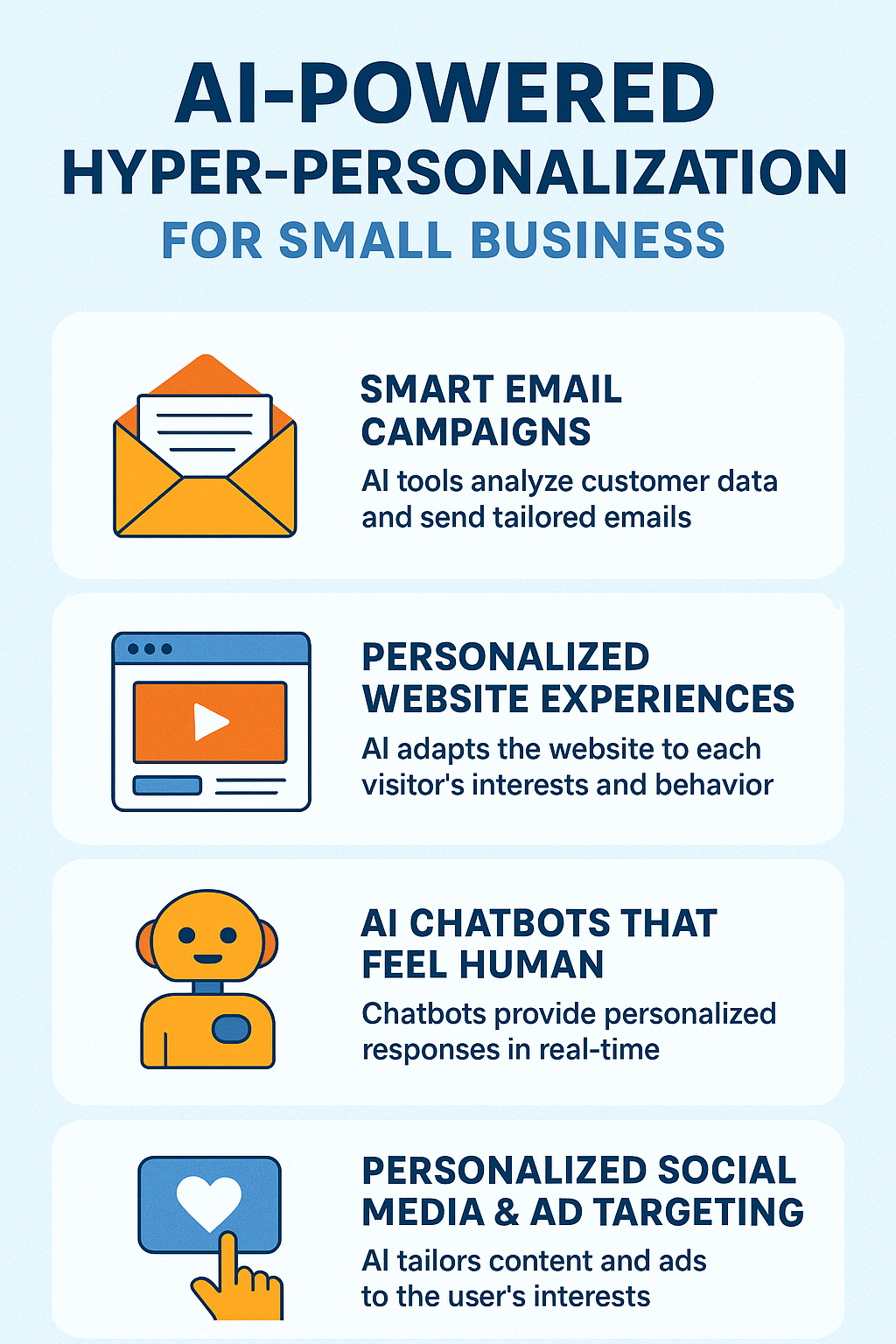
1. Smart Email Campaigns

AI tools can analyze your customer list and automatically send tailored emails based on:

  • Past purchases

  • Seasonal interests

  • Engagement history

  • Customer behavior on your website

Examples:

  • A bakery sends “Buy One Get One” offers to customers who regularly buy treats.

  • A salon sends personalized reminders based on each customer’s typical appointment cycle.

2. Personalized Website Experiences

AI-driven website tools can adapt content for each visitor.

Examples:

  • Show products similar to what a visitor viewed last time.

  • Promote local events or services based on location.

  • Offer coupons to returning customers who haven’t purchased recently.

Even small businesses using Shopify, WordPress, or Squarespace can integrate these tools easily.

3. AI Chatbots That Feel Human

Modern chatbots do far more than answer FAQs — they analyze behavior and personalize responses in real time.

Uses include:

  • Offering product recommendations

  • Booking appointments

  • Guiding shoppers to the right service

  • Following up with tailored messages

This creates a 24/7 sales assistant without added staffing costs.

4. Personalized Social Media & Ad Targeting

AI can help you tailor posts, captions, and offers by analyzing what your audience engages with most.

For ads, AI can automatically create:

  • Lookalike audiences

  • Interest-based segments

  • Dynamic ads showing the exact product someone viewed yesterday

This saves money and increases ROI.

5. Predictive Recommendations

AI can anticipate what customers might want next.

Examples:

  • A fitness studio recommends classes based on past attendance.

  • A boutique suggests outfits that match previous purchases.

  • A landscaping company sends seasonal service reminders tailored to each customer’s yard history.

Predictive personalization increases repeat business — one of the most valuable revenue drivers for small companies.

What Small Businesses Need to Get Started

You don’t need a tech team. You only need:

  • A CRM (customer relationship management system) or customer list

  • A data source (website analytics, email behavior, purchase history)

  • An AI tool (many are affordable or even free)

  • Clear goals — more leads, higher sales, better retention, etc.

Final Thoughts: AI Levels the Playing Field for Small Businesses

AI-powered hyper-personalization is no longer a luxury — it’s a competitive advantage. It helps small businesses deliver tailored experiences that keep customers engaged and loyal, all while saving time and costs.

When done right, hyper-personalization turns simple interactions into meaningful customer relationships — and meaningful relationships into increased revenue.

Leverage AI-Powered Hyper-Personalization to Boost Business Growth Infographic

Why “AI-Driven Personalization & Automation” Is Trending

Why “AI-Driven Personalization & Automation” Is Trending

Trending Marketing Topics (with Data) for Google + Facebook Marketers in 2025

Here are some of the biggest, evidence-based trends shaping digital marketing right now — backed by recent reports and industry data.

1. AI-Powered Personalization & Predictive Analytics

  • According to Adobe’s 2025 Digital Trends Report, 65% of senior execs say AI + predictive analytics will be a core driver of growth.

  • Generative AI in digital marketing is projected to grow massively — one market report estimates it will go from $2.48B in 2024 to $35.12B by 2034.

  • Many companies (per the IntelligenceBank Content Marketing Trends Report) are using AI for content ideation, real-time personalization, and workflow automation.

Why it matters:

  • On Google, AI + predictive analytics helps you serve more relevant search ads and content.

  • On Facebook / Meta, AI helps optimize ad creative, audience targeting, and dynamic personalization in real time.

How to use it:

  • Use AI tools for personalized content (emails, landing pages, ads)

  • Leverage predictive analytics to forecast customer behavior and tailor campaigns

  • Test generative AI for ad creative + copy, but always A/B test

2. Search Experience Optimization (SXO) / Generative Engine Optimization (GEO)

  • According to several sources, Google’s AI-powered “overviews” are reshaping how people interact with search results.

  • Semrush’s 2025 trends highlight that AI is shifting SEO from pure keyword focus to contextual experience and intent.

  • There’s also growing talk of “Generative Engine Optimization” (GEO) — optimizing content so it’s more likely to be used / cited by AI-powered search/chat systems.

Why it matters:

  • With Google, more searches could be answered directly by AI or “search summary” features.

  • On Meta, SEO-style content that is optimized for AI (GEO) can help attract more organic and referral traffic.

How to use it:

  • Structure content for featured snippets, FAQ, and AI citation (clear, authoritative)

  • Create content designed to answer user intent, not just target keywords

  • Use schema, structured data, and other SEO best practices to help AI systems understand your content

3. First-Party Data & Privacy-First Marketing

  • According to a Q1 2025 industry update, 82% of marketers are prioritizing first-party data collection.

  • With the decline of third-party cookies and stricter privacy rules, first-party data (customer data collected directly) has become more valuable.

  • AI + predictive analytics, when combined with first-party data, can deliver hyper-personalized experiences.

Why it matters:

  • On Google Ads, you can use first-party data to build more accurate audiences, retarget, and optimize.

  • On Facebook, first-party data (like email lists, CRM data) can feed into custom audiences, lookalikes, and (with AI) more precise ad targeting.

How to use it:

  • Build and enrich your first-party data: email lists, CRM, website interactions

  • Use that data to create tailored ad audiences

  • Leverage privacy-first strategies (transparency, consent, data ethics) in your marketing

4. Voice, Image & Multimodal Search

  • Voice search continues to matter: as more people use voice assistants, brands need to optimize for conversational queries.

  • Search is becoming more multimodal: text + image + voice queries are all important.

  • B2B e-commerce trends report (Algolia) also suggest that AI-powered site search and discovery (leveraging multimodal inputs) is a big focus.

Why it matters:

  • On Google, optimizing for voice and visual search can help your content surface in new ways

  • On Facebook / Instagram, multimodal content (images, video, interactive formats) resonates more — especially when paired with AI-driven personalization

How to use it:

  • Create content using conversational, question-based keywords

  • Optimize pages for visual search (alt text, structured data)

  • Use short-form, interactive, and visual content in your ads and organic social strategy

5. AI Ethics, Explainability & Responsible Use

  • As marketers use more AI, there’s growing scrutiny around transparency and ethics: how AI decisions are made, how data is used, and how content is generated. This is showing up in many “AI in marketing” trend reports.

  • According to HumansWith.ai, the cost-saving benefits of AI are huge but marketers are also focusing on brand trust, authenticity, and governance.

Why it matters:

  • On Google, how you use AI in content and ads can influence brand reputation + compliance.

  • On Facebook, users are sensitive to inauthentic or overly automated content — balancing AI automation with real human touch will be key.

How to use it:

  • Be transparent when using AI-generated content (e.g., disclose in content if appropriate)

  • Use AI tools that provide “explainable” outputs when possible

  • Combine AI efficiency with human storytelling and oversight

Visualizing the Trend Growth (Hypothetical / Data-Backed)

Here’s a simple projected trend growth model (based on industry reports and forecasts):

Trend Estimated 2025 Impact Growth Signal
AI Personalization & Predictive Analytics High – major budget shift Adobe report: 65% execs prioritizing Adobe Business
Generative / GEO Search Optimization Very high – new SEO paradigm Semrush + academic research Semrush
First-Party Data & Privacy-First Marketing Medium–High Industry sources showing widespread prioritization Kreativa Inc
Voice / Multimodal Search Medium Multiple sources call it “next search frontier” LinkedIn
AI Ethics & Responsible Use Growing concern + priority Experts emphasizing AI governance HumansWithAI

Why These Trends Matter for Facebook + Google Marketers

  • Budget Efficiency: AI + predictive analytics help you get more ROI from ad spend on both Google and Meta.

  • Audience Targeting: First-party data + AI = smarter lookalikes, better retargeting.

  • Content Strategy: GEO / AI-optimized content helps you rank for conversational / AI-driven search.

  • User Experience: More personalized interactions build loyalty and trust.

  • Brand Trust: Using AI responsibly builds credibility with your audience.